When I took over this e-commerce blog in 2025, much of the content had been published once and left alone.
Articles were heavily dependent on individual products. When those products disappeared from stock, large parts of the content stopped being useful.
Older buying guides weren’t being systematically updated and the blog wasn’t being treated as a commercial asset.
I changed how we approached it.
Instead of publishing product-led articles and moving on, I started building and maintaining buying guides around the questions people ask before they buy.
The work included:
- rewriting older articles so they could survive individual products going out of stock
- targeting commercial and comparison intent
- adding clearer buying criteria and recommendations
- updating outdated information, prices and products
- improving internal linking between related guides and commercial pages
- building topic clusters around major product categories
- treating existing content as something to maintain, rather than something finished the day it was published
The goal was simple: make the blog more useful at the moment someone was deciding what to buy.
From product descriptions to durable buying guides
One recurring problem was that older shopping guides were built around describing individual products. If three of five products disappeared from stock, the article effectively collapsed.
I rewrote these pages around durable buying criteria, use cases, price ranges and product categories, then treated individual recommendations as a layer that could be updated without rebuilding the whole article.
The result
In September 2026, Google Search Console introduced its Generative AI report.
For the first time, I could see how the blog itself was performing across Google’s generative AI search features.
As of September 14, 2026, blog URLs had generated 79,695 Generative AI impressions over the previous three months, compared with 12,520 in the preceding three-month period.
That is a 6.37× increase in AI search visibility.
Across the entire e-commerce domain, Generative AI impressions grew from 51,299 to 303,046 over the same periods, a 5.91× increase.
The distribution across individual pages was even more striking.
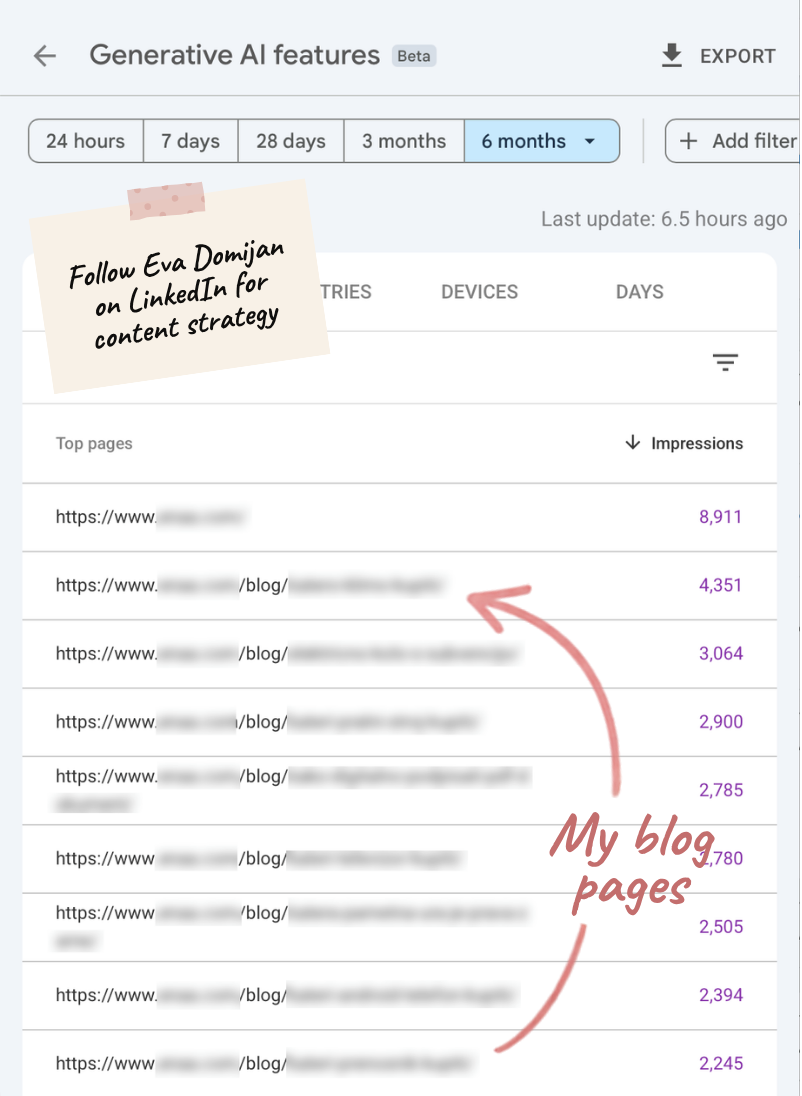
Of the ten pages with the highest Generative AI visibility on the domain, nine were blog articles I manage. The only page above them was the homepage.
Why I believe the content performed
The strongest-performing articles on this e-commerce blog share a pattern.
They are built around purchase decisions rather than generic product descriptions.
They answer questions such as:
- Which product should I buy?
- What is the difference between these options?
- Which specification actually matters?
- What should I choose for my particular use case?
- How much should I expect to pay?
They also connect informational content closely to products and categories people can actually buy.
That combination matters for an e-commerce site.
A buying guide should help someone make a decision and make the next commercial step easy.
The business result
Before the Generative AI report existed, the blog was already producing stronger commercial results.
By June 2026, monthly blog revenue had grown from €1,408 to €6,606 over six months, a 4.7× increase.
The later Generative AI data added a second signal: blog articles dominated the domain’s highest-visibility pages in AI search.
These are separate outcomes measured at different times, so I would not claim that AI visibility caused the revenue growth.
What they show together is that the blog was becoming both a stronger commercial asset and a more visible source across newer search surfaces.
My role
I was responsible for the blog’s content strategy and day-to-day execution: choosing and prioritising topics, rewriting and updating older articles, shaping buying guides around commercial and comparison intent, improving internal linking, building topic clusters, and maintaining recommendations, prices and product information over time.
I used Google Search Console, GA4 and Google Keyword Planner to identify search demand, prioritise existing content, find commercial opportunities, monitor performance and decide which articles needed to be updated, expanded or rewritten.
I also handled the blog’s on-page content decisions, including article structure, headings, search intent, titles, meta descriptions and internal anchors.
An external SEO specialist works on backlink acquisition for the wider e-commerce business, but those backlinks are built to the shop, such as product and category pages, rather than to the blog.
The blog did not have a dedicated backlink-building programme behind this growth.
That matters when interpreting the results: the blog’s increasing visibility came while my work was focused primarily on the content itself, its structure, maintenance and connection to the commercial parts of the site.
Want more visibility in AI search?
If your e-commerce blog is sitting on years of content but you’re unsure what to update, what to build next or how to make it more visible in AI search, I can help.
I work with e-commerce businesses on content strategy, buying guides, commercial search intent and content systems designed to improve search visibility and support revenue.
If you’d like to discuss an e-commerce content audit, send me a DM on LinkedIn: https://www.linkedin.com/in/evadomijan/